Lecture 7 - Transactions and concurrency pt.2
# Locks and Time
# Tree Protocol
- Only exclusive locks are considered.
- The first lock may be on any data item.
- Subsequently, a data item can be locked only if its parent is currently locked by the same transaction.
- Data items may be unlocked at any time.
- A data item that has been locked and unlocked cannot be subsequently re locked by the same transaction.
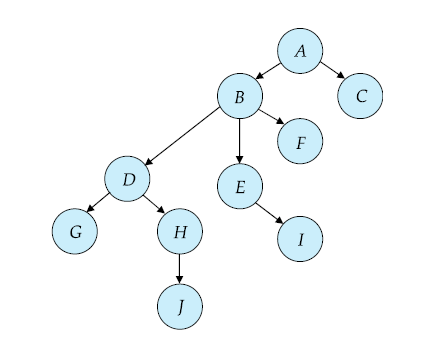
The tree protocol ensures conflict serializability as well as freedom from deadlock
Drawbacks
- Protocol does not guarantee recoverable or cascadeless schedules
- Need to introduce commit dependencies to ensure recoverability
- Transactions may have to lock data items that they do not access increased locking overhead, and additional waiting time potential decrease in concurrency
# Granularity Hierarchy
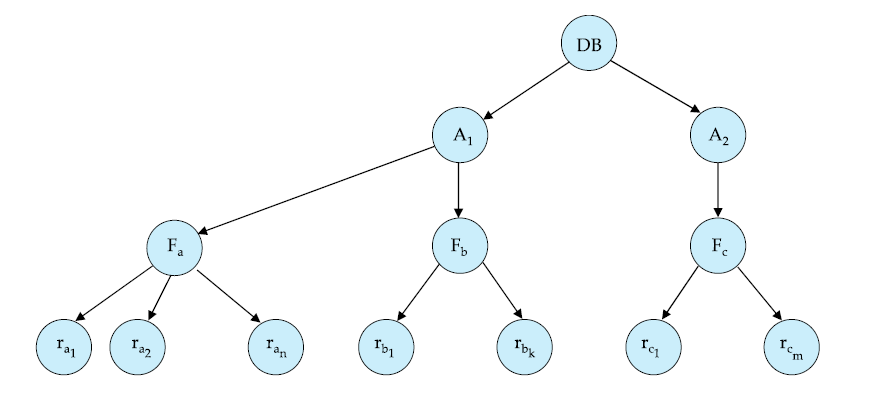 The levels, starting from the coarsest (top) level can be
- database, area, file, record
- database, table, page, row (as in SQL Server) etc.
When a transaction locks a node in S or X mode, it implicitly locks all descendants in the same mode (S or X).
# Intention Lock Modes
- intention shared (IS): indicates there are shared locks at lower levels of the tree
- intention exclusive (IX): indicates there are exclusive or shared locks at lowers level of the tree
- shared and intention exclusive (SIX): a shared lock, with the possibility of having exclusive or shared locks at lower levels of the tree.
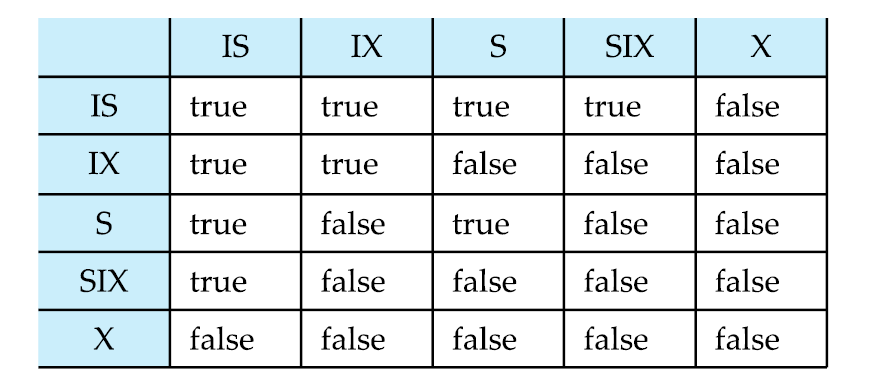
- The root of the tree is locked first in some mode (IS, IX, S, SIX, X).
- If a node is locked in IS mode, its descendants can be locked in IS or S mode.
- If a node is locked in IX mode, its descendants can be locked in any mode.
- If a node is locked in S mode, its descendants are implicitly locked in S mode.
- If a node is locked in SIX mode, its descendants are implicitly locked in S mode, but can also be locked IX, SIX, or X mode.
- If a node is locked in X mode, its descendants are implicitly locked in X mode.
# Timestamp Based Protocols
Each transaction Ti is issued a timestamp TS( Ti ) when it enters the system.
- Each transaction has a unique timestamp
- Newer transactions have timestamps greater than earlier ones
- Timestamp can be based on wall clock time or logical counter Timestamp based protocols manage concurrent execution such that timestamp order = serializability order
# Timestamp Ordering Protocol
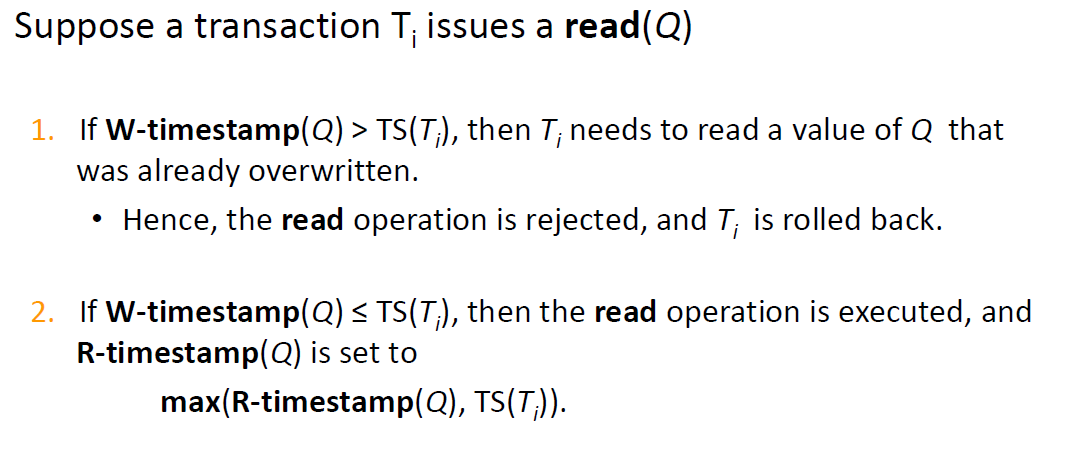
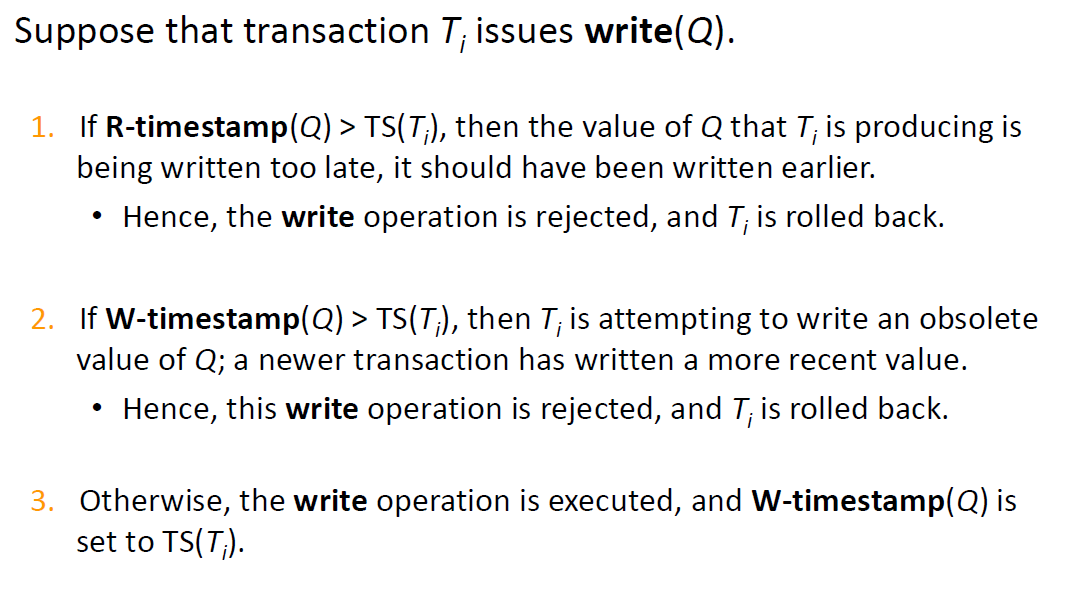
Maintains for each data Q two timestamp values:
- W-timestamp( Q ) is the largest timestamp of any transaction that executed write( Q )
- R-timestamp( Q ) is the largest timestamp of any transaction that executed read ( Q )
Imposes rules on read and write operations to ensure that
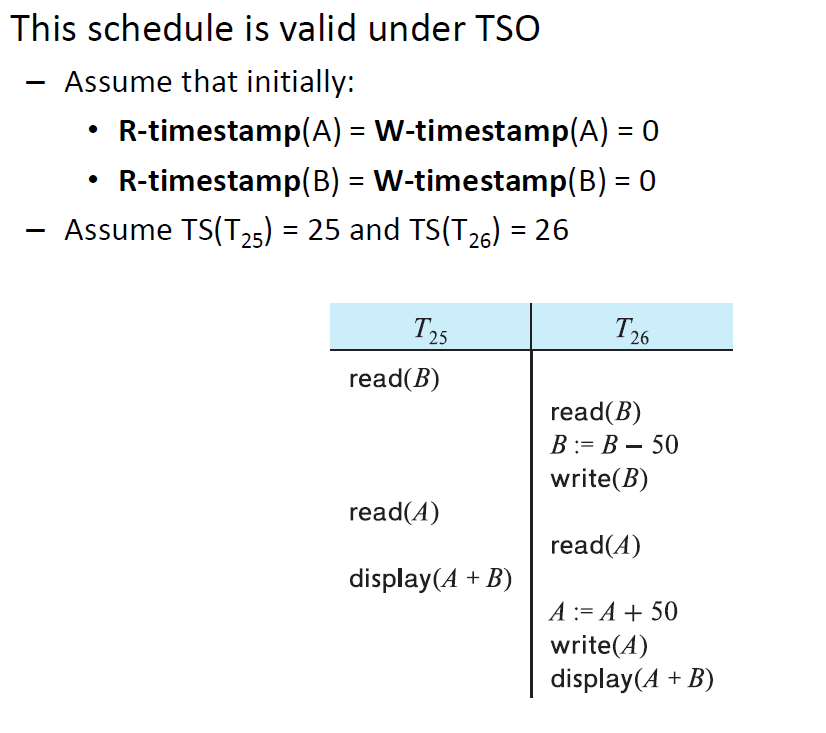
- Any conflicting operations are executed in timestamp order
- Out of order operations cause transaction rollback

# Multiversion Timestamp Ordering
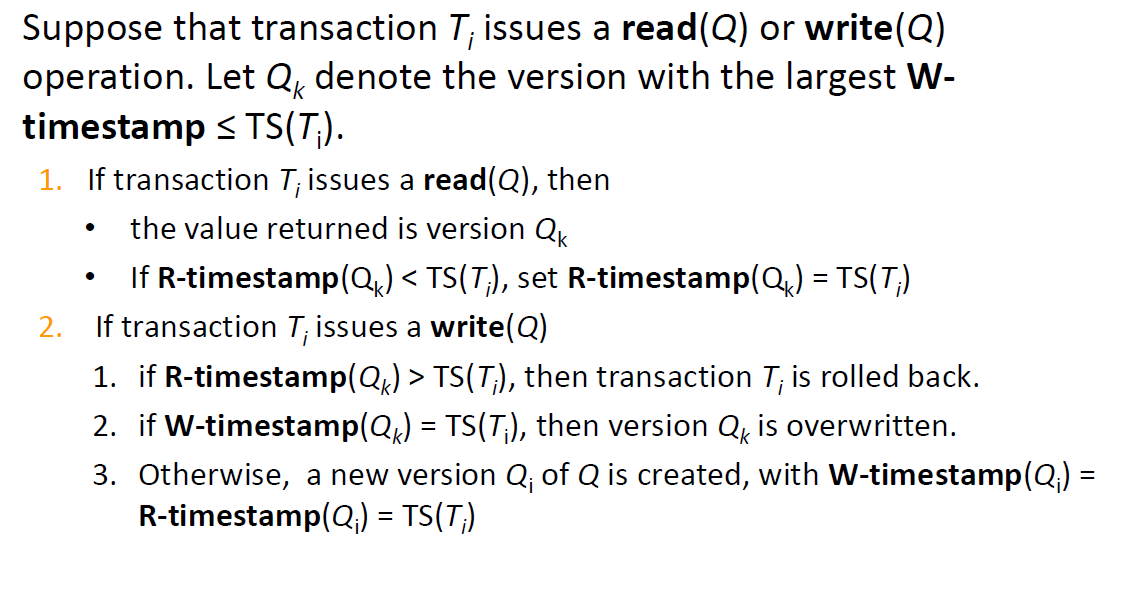
- Each data item Q has a sequence of versions < Q 1 , Q 2 ,…., Q m >
- Each version Q k has its own timestamps:
- W-timestamp( Qk ) timestamp of the transaction that created (wrote) version Qk
- R-timestamp( Q( k ) largest timestamp of a transaction that successfully read version Qk
Notes
- Read requests never fail and never wait.
- A write by Ti is rejected if some newer transaction Tj that should read Ti ’s version, has read a version created by a transaction older than Ti
- Protocol guarantees serializability
- but does not ensure recoverability or cascadelessness
# Snapshot Isolation
- Widely used in practice (incl. Oracle, PostgreSQL, SQL Server, etc.)
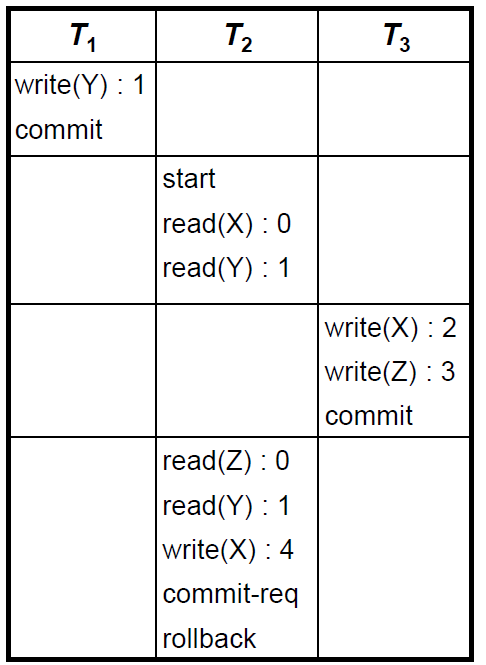
- Each transaction is given its own snapshot of the database
- Transactions that update the database have potential conflicts
- Read requests never wait
- Read only transactions never fail
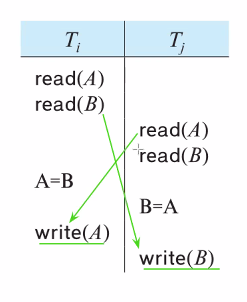
Snapshot isolation does NOT ensure serializability
- Ti reads A and B , updates A based on B
- Tj reads A and B , updates B based on A
- Updates are on different objects; both are allowed to commit but the result is not equivalent to a serial schedule
- Schedule is not conflict serializable Precedence graph has a cycle
- This anomaly is called a write skew
Lecture 6 Transactions and concurrency | Lecture 8 Database Recovery