Lecture 6 - Transactions and concurrency
# “We want performance”
# Transaction Concept
- Unit of a program.
- Group of ops that are executed as a whole
- Maintain a consistent state in the system
- Inconsistent while inside de transaction
# Main issues
- Concurrent execution of multiple transactions
- Failures of various kinds, such as hardware failures and system crashes
Focus on READ and WRITE
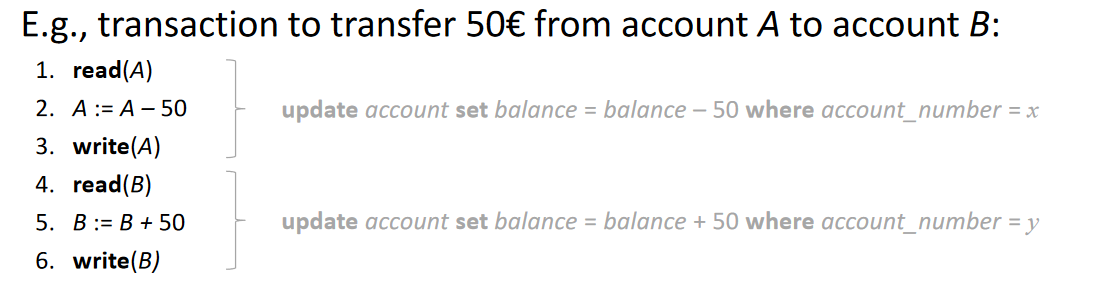
If fails in the middle -> ROLLBACK
# ACID
- Atomicity. Either all operations of the transaction are properly reflected in the database or none are.
- Consistency. Execution of a transaction in isolation preserves the consistency of the database.
- Isolation. Although multiple transactions may execute concurrently, each transaction must be unaware of other concurrently executing transactions. Intermediate transaction results must be hidden from other concurrently executed transactions.
- That is, for every pair of transactions Ti and Tj, it appears to Ti that either Tj, finished execution before Ti started, or Tj started execution after Ti finished.
- Durability. After a transaction completes successfully, the changes it has made to the database persist, even if there are system failures.
# Transaction State
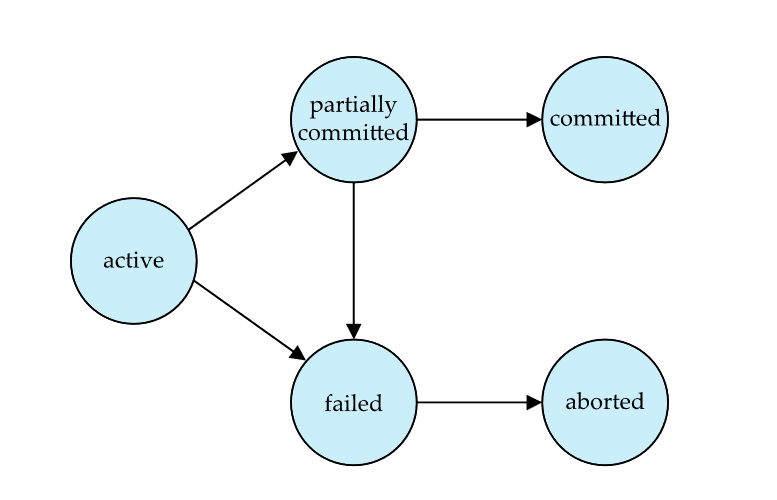
- Active – the initial state; the transaction stays in this state while it is executing
- Partially committed – after the final statement has been executed. (Higher concurrency causes more of this state)
- Failed – after the discovery that normal execution can no longer proceed.
- Aborted – after the transaction has been rolled back and the database restored to its state prior to the start of the transaction.
Two options after it has been aborted:- Restart the transaction
- Can be done only if no internal logical error
- Kill the transaction
- Restart the transaction
- Committed – after successful completion.
Schedule: a sequences of instructions that specify the
chronological order in which instructions of concurrent
transactions are executed
Serial Mode: One transaction at the time (1 after the other) Schedule 1 is T1 and T2 in Serial Mode This one is Schedule 3
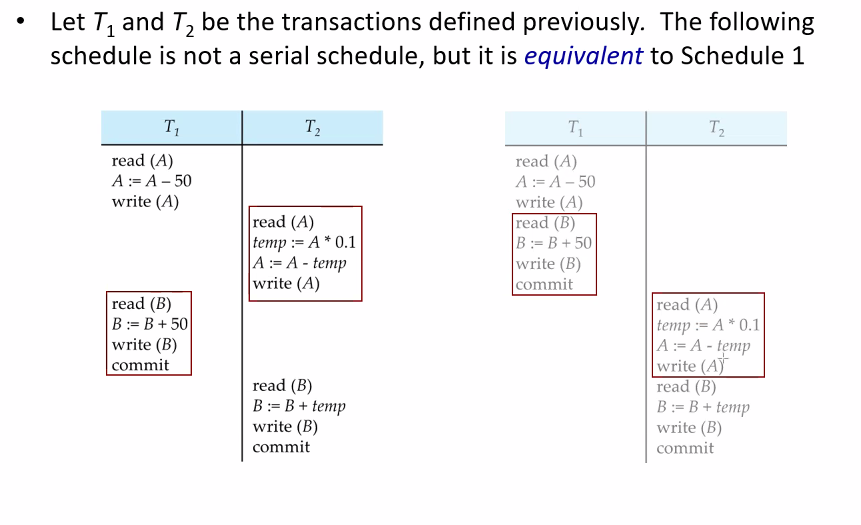
We can switch the order of blocks if they operate in diff objs
Basic Assumption – Each transaction preserves database
consistency.
We focus on a particular form of schedule equivalence called
conflict serializability
# Conflicting Instructions
- Ti : read(Q) Tj : read(Q) No conflict
- Ti : read(Q) Tj : write(Q) Conflict
- Ti : write(Q) Tj : read(Q) Conflict
- Ti : write(Q) Tj : write(Q) Conflict
Forces temporal order: usually the older transaction executes first
# Conflict equivalent
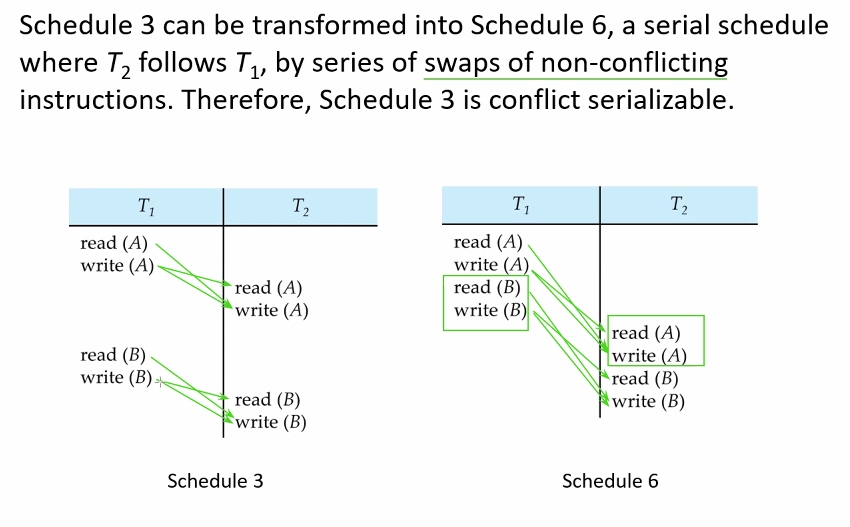
If a schedule S can be transformed into a schedule S’ by a series
of swaps of non-conflicting instructions, we say that S and S’ are
conflict equivalent.
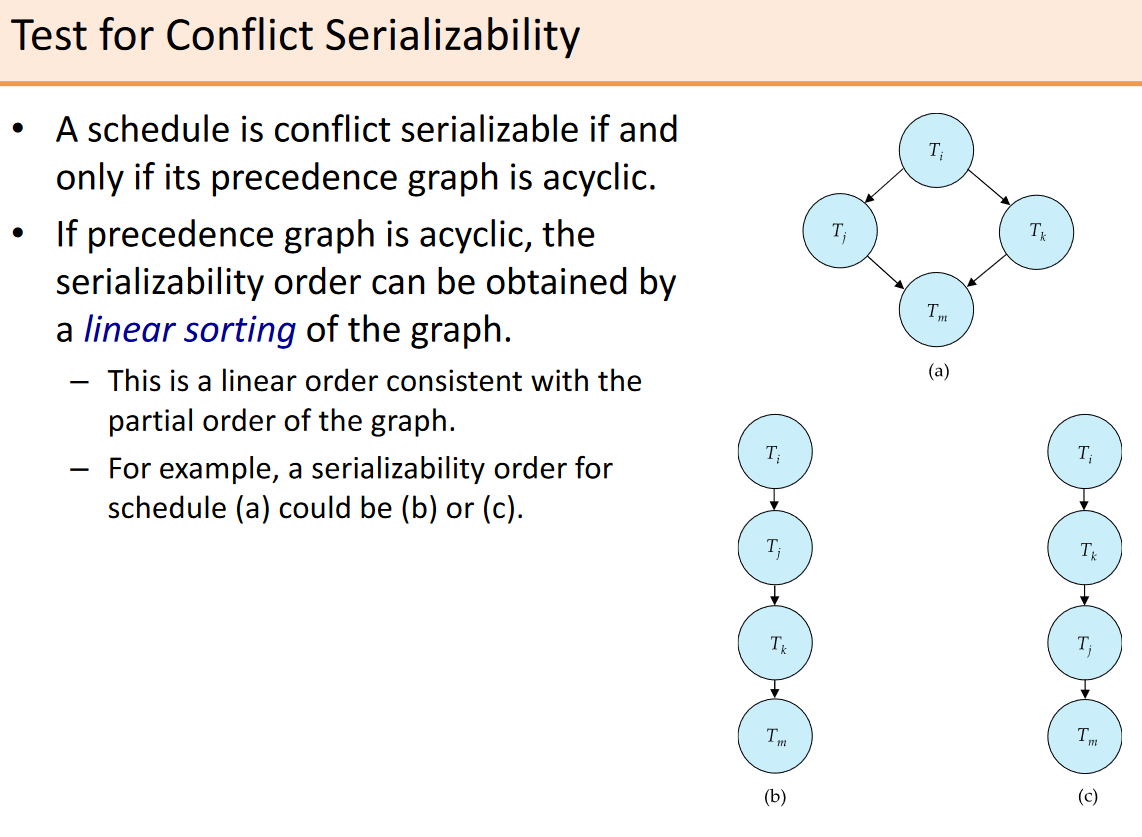
# Conflict serializable
We say that a schedule S is conflict serializable if it is conflict
equivalent to a serial schedule.
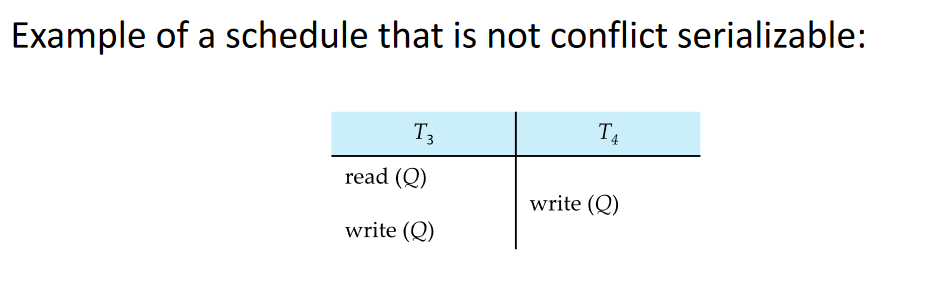
(Does not follow the “Precedence Graph”)
We are unable to swap instructions in the above schedule to obtain either
the serial schedule < T3 , T4 >, or the serial schedule < T4 , T3 >.
# Recoverable Schedules
- If transaction Tj reads a data item previously written by a transaction Ti , then the commit of Tj must appear after the commit of Ti
- The following schedule is not recoverable:
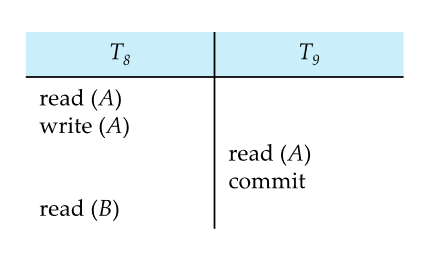
- If T8 rolls back, T9 has read an inconsistent database state.
- Database must ensure that schedules are recoverable. Can only commit T9 after T8
# Cascading rollback
- A single transaction failure leads to a series of transaction rollbacks.
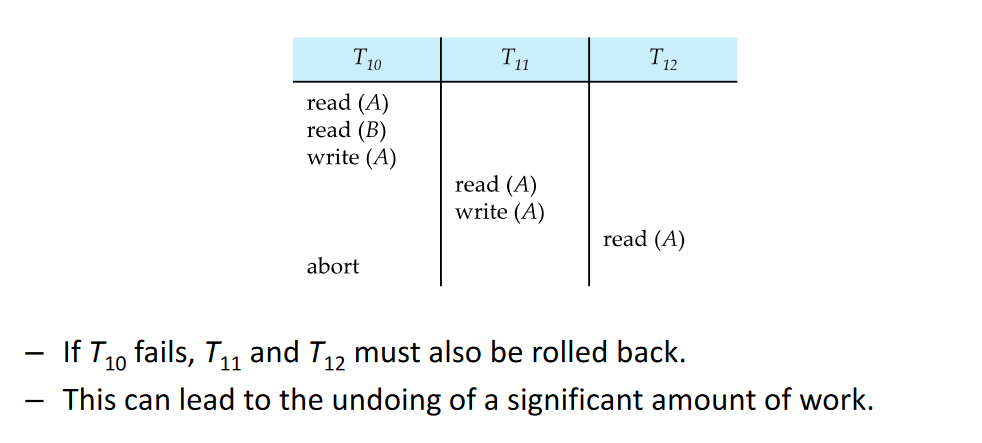
(the schedule is recoverable)
# Cascadeless schedules
- cascading rollbacks cannot occur
- Every cascadeless schedule is also recoverable
- Because if the read of Tj appears after the commit of Ti, then the commit of Tj will also appear after the commit of Ti
- It is desirable to restrict the schedules to those that are cascadeless
# Levels of Consistency in SQL
- Serializable — ensures serializable execution.
- Repeatable read — only committed records to be read.
- Repeated reads of same record must return same value.
- However, a transaction may not be serializable; it may find some records inserted by a transaction but not find others.
- Read committed — only committed records can be read.
- Successive reads of a record may return different (committed) values.
- Read uncommitted — even uncommitted records may be read.
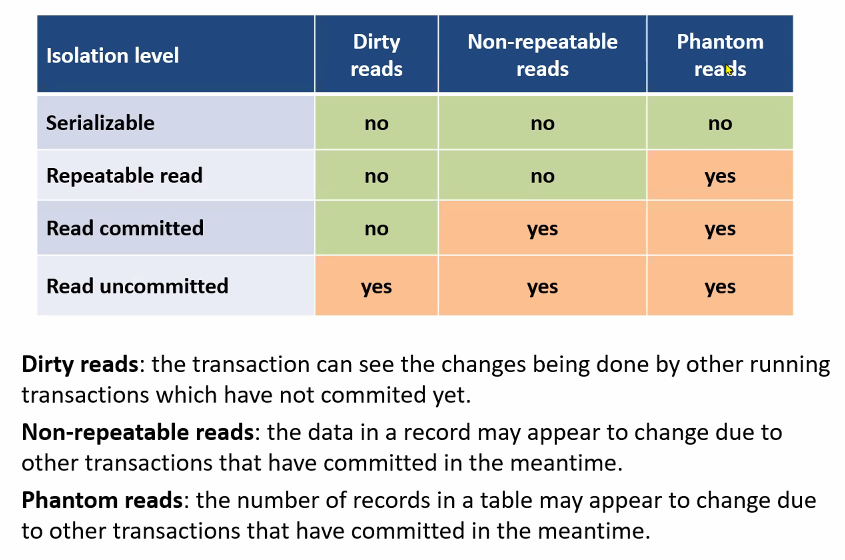 Analysis Queries can benefit for “Read Uncommited” as it is the fastest (and full parallel)
In SQL Server the default is READ COMMITTED (preferes a performance approach)
Some systems have additional isolation levels
- Snapshot isolation (not part of the SQL standard) each transaction works on its own snapshot of the data.
- When commiting a problem might arise as each transaction spanshot might be different
- It allows no conflicts while inside the transaction, but problems in commit
# Implementation of Isolation Levels
(Locking, Timestamps, Multiple versions of each data item)
# Locking
- Lock on entire database vs. lock on items
- How long to hold lock?
- Shared vs. exclusive locks
- Exclusive (X) mode. Data item can be both read as well as
written. X-lock is requested using lock-X instruction. - Shared (S) mode. Data item can only be read. S-lock is
requested using lock-S instruction.
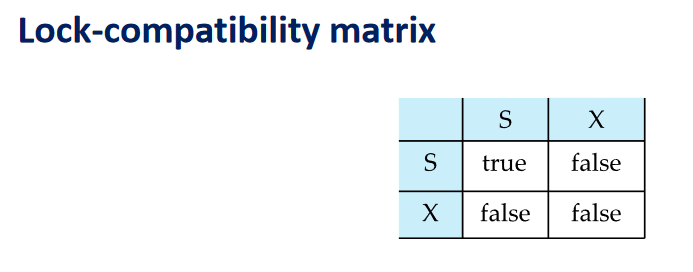
Bad Lock example:
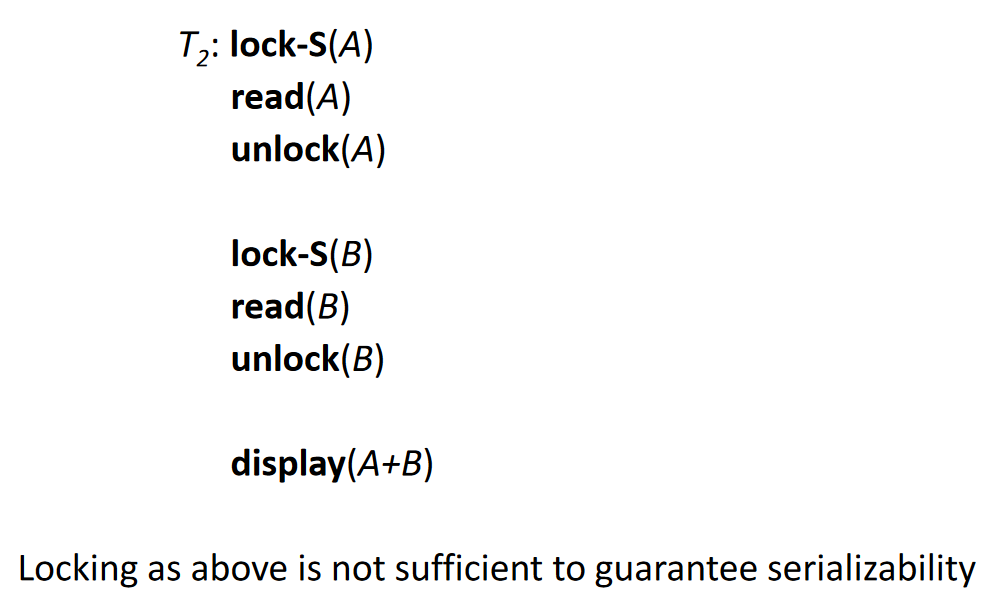
You should not release a lock inside a transaction
# 2-Phase Locking
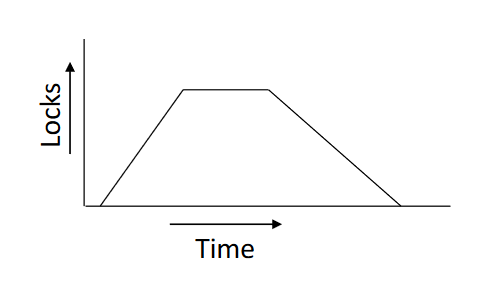
A protocol which ensures conflict-serializable schedules
- Phase 1: Growing Phase
- Transaction may obtain locks
- Transaction may not release locks
- Phase 2: Shrinking Phase
- Transaction may release locks
- Transaction may not obtain locks
- The protocol assures serializability
- It can be proved that the transactions can be serialized in the order of their lock points
Does not PREVENT DEADLOCKS
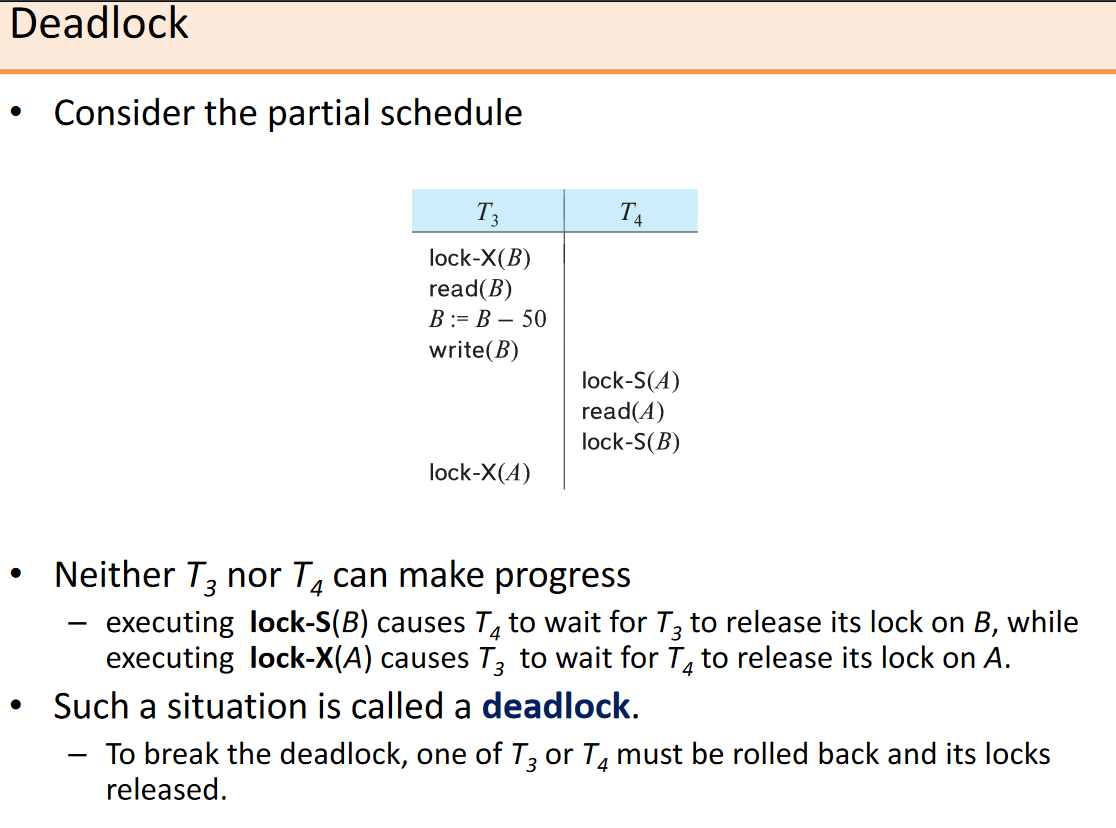
- The problem is that the transactions are locking in reverse order (B, A and A, B)
- The potential for deadlock exists in most locking protocols.
- Starvation is also possible if concurrency control manager is badly designed. For example:
- A transaction may be waiting for an X-lock on an item, while a sequence of other transactions request and are granted an S-lock on the same item.
- The same transaction is repeatedly rolled back due to deadlocks.
- Concurrency control manager can be designed to prevent starvation.
Lecture 5 Query Optimization | Lecture 7 Transactions and concurrency pt2